Introduction to UAV Motors
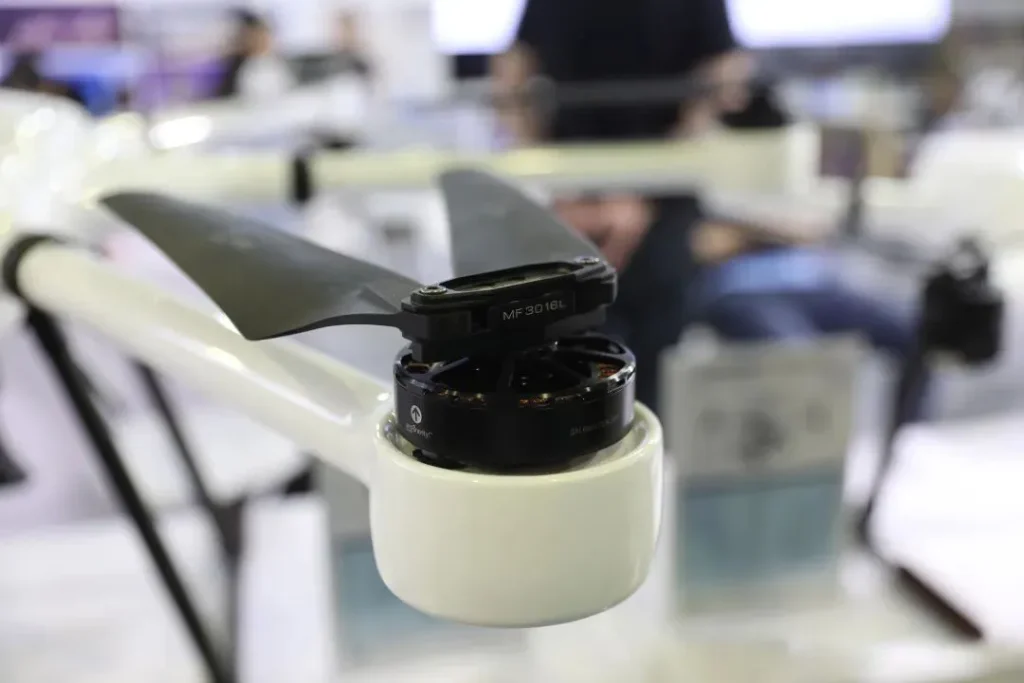
UAV motors are the cornerstone of modern drone technology, serving as the primary power source that converts electrical energy into mechanical motion. They play a critical role in driving propellers to generate lift and thrust, enabling stable and efficient flight. The performance of UAV motors directly determines key operational metrics such as flight efficiency, endurance, payload capacity, and overall reliability. As the demand for UAVs continues to expand across industries, motor technology has become a focal point for innovation and optimization.
Core Operating Principles
1. Brushless Motor Fundamentals
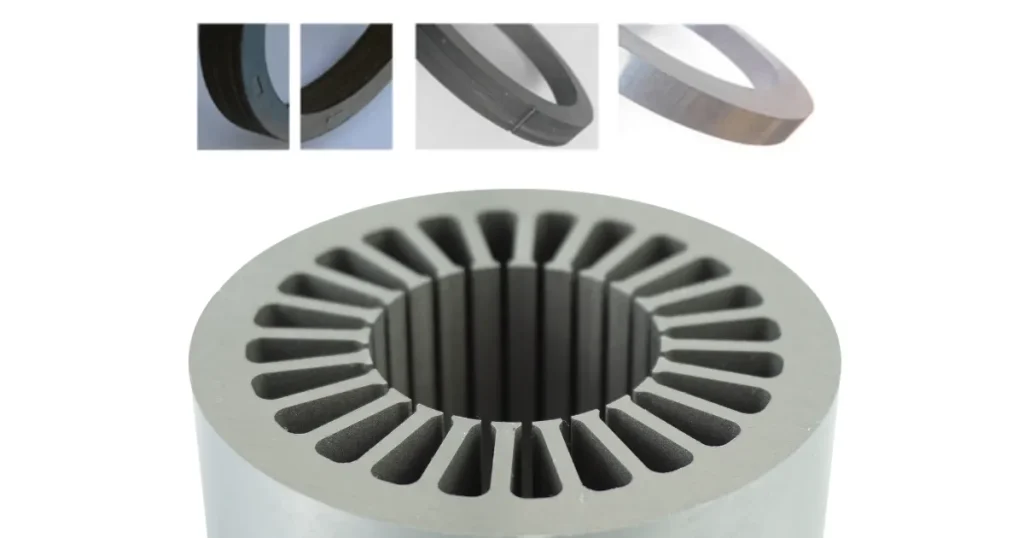
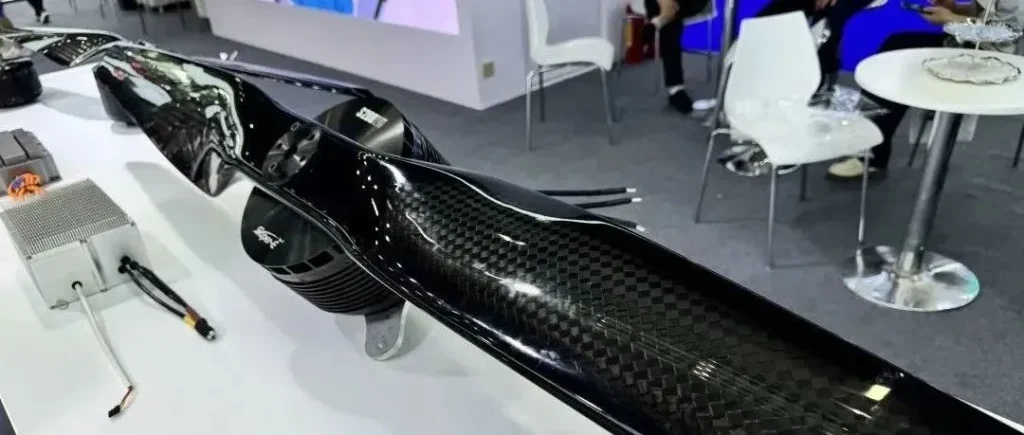
Brushless DC motors are primarily composed of a rotor with magnetic poles, a stator with multiple coil windings, and Hall effect position sensors (optional). The working principle is based on electromagnetic induction and magnetic field interaction. The stator includes multiple coils, typically made from insulated wire and fixed to the motor housing. The rotor is made of permanent magnets, usually arranged in a specific pattern. An electronic speed controller (ESC) controls the current in the stator coils, generating a magnetic field that causes the rotor to rotate. Its advantages include high efficiency, high power density, low noise, and long lifespan. The functions of each part:
- Stator Windings: Generate a rotating electromagnetic field.
- Permanent Magnet Rotor: Converts the magnetic field into rotational motion.
- Hall Sensors: Detect rotor position to facilitate precise electronic commutation.
2. Electronic Speed Controller (ESC) Integration
The Electronic Speed Controller (ESC) in drones is the core control unit of the power system, responsible for converting the direct current from the battery into three-phase alternating current to drive brushless motors. It precisely regulates the motor speed and direction by receiving commands from the flight controller. Its core functions include: power conversion, dynamic speed adjustment, safety protection, and auxiliary power supply.
3. Quadcopter Torque Balance
The torque balance in a quadrotor is achieved by having diagonal motors rotate in opposite directions, canceling each other’s counter torque from air resistance. The four motors are arranged symmetrically (in a cross or X pattern), with the two on each diagonal rotating the same way (e.g., M1 and M3 counterclockwise, M2 and M4 clockwise) so that adjacent motors rotate oppositely. When all motors run at the same speed, their opposing torques cancel, preventing the aircraft from spinning. For yaw control, adjusting the speed difference between the diagonal pairs breaks the balance and creates a rotational moment. This setup also reduces gyroscopic effects, ensuring stable hover and precise control through ESC adjustments.

Key Types of UAV Motors
| Motor Type | Structural Characteristics | Advantages | Limitations | Typical Applications |
|---|---|---|---|---|
| Brushed DC Motor | Mechanical commutation via brushes | Low cost, simple control | Short lifespan, low efficiency | Toy drones, micro UAVs |
| Brushless DC Motor | Electronic commutation with permanent magnets | High efficiency, long lifespan | Complex control circuitry | Consumer/industrial UAVs |
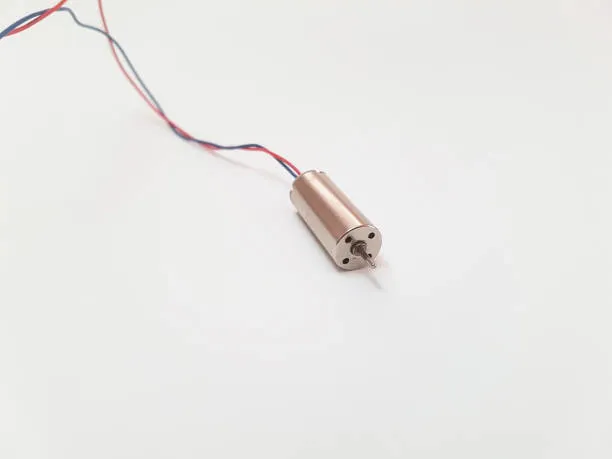
| Coreless Motor | Rotor without iron core | Fast response, high energy density | Limited power output | Lightweight drones |
| Servo Motor | Integrated encoder with closed-loop control | High precision control | Higher cost | Gimbals, tethered drones |
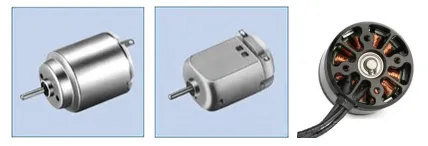
Among these motor types, brushless DC motors dominate the UAV industry due to their optimal balance of performance, efficiency, and durability. Coreless motors are preferred in lightweight or micro-UAV applications where rapid response is critical.
Key Performance Metrics
1. KV Rating
The KV rating represents the motor’s no-load rotational speed per volt (RPM/V). It is a critical parameter for determining speed and torque characteristics:
- High KV motors (>3000 KV): Designed for high-speed applications such as racing drones.
- Low KV motors (<400 KV): Optimized for torque-heavy tasks like agricultural spraying or logistics drones.
2. Voltage and Current Ratings
- Operating voltage typically ranges from 3S to 12S LiPo batteries (11.1V–44.4V).
- Continuous current ratings define thermal limits under sustained operation, while peak current ratings indicate short-term overload capacity.
3. Mechanical Parameters
- Stator Dimensions: For instance, a “2207” motor has a stator diameter of 22mm and height of 7mm.
- Shaft Diameter: Common sizes include 1.5mm, 2mm, or 3mm.
- Weight: Ranges from lightweight models (
15g) to heavy-duty industrial motors (200g).
4. Thrust-to-Power Ratio
Efficiency is measured as thrust-to-power ratio (grams per watt). This metric is crucial for optimizing flight endurance while maintaining sufficient lift.
5. Thermal Management
Effective heat dissipation ensures consistent performance under high loads. Advanced materials such as aluminum-nitride ceramic substrates are increasingly used to improve thermal conductivity.
Motor Selection Guidelines
The selection of UAV motors must comprehensively consider the application scenario, load requirements, and endurance objectives.
Key parameters include the KV rating (high KV paired with small propellers for rapid response, and low KV with large propellers to enhance torque efficiency), stator dimensions (e.g., a “2206” indicates a 22 mm diameter and 6 mm height, which directly affect thrust and power), and efficiency metrics (measured in g/W, optimized within a 3–5 A current range). Additionally, ESC compatibility must be verified (with a current carrying capacity of at least 1.2 times the motor’s peak current) as well as heat dissipation and protection capabilities (industrial-grade motors should have an IP54 rating or higher). Priority should be given to reputable brands that provide complete datasheets and efficiency curves to ensure stable performance.
Advanced Technical Feature
Magnetic Circuit Design
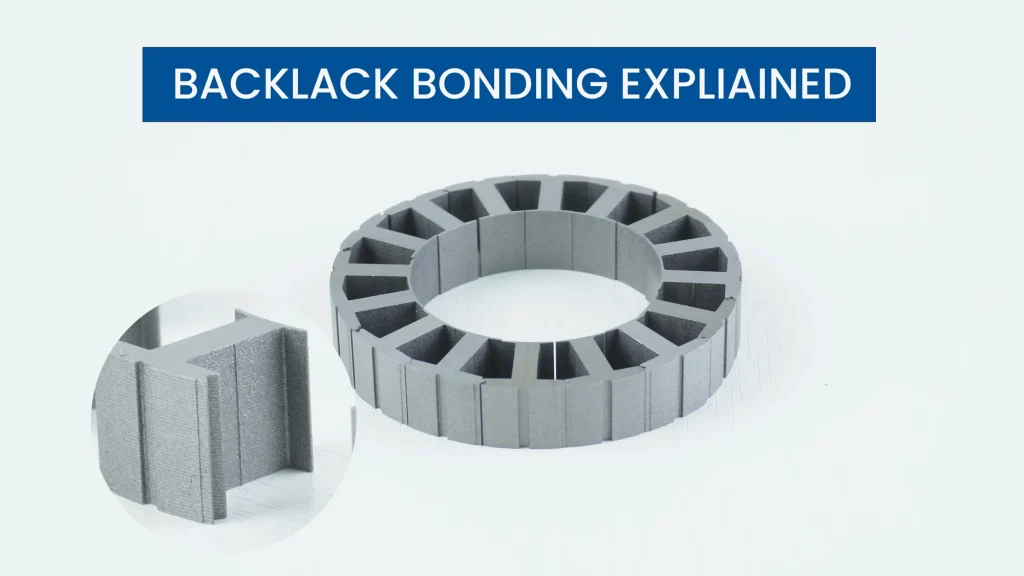
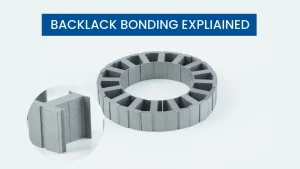
In the magnetic circuit design of UAV motors, the skewed slot structure is one of the key methods for reducing cogging effects. Its principle is to alter the geometric symmetry of the stator or rotor, thereby dispersing the periodicity of the magnetic conductance variations and consequently diminishing the fundamental and harmonic components of the cogging torque.
Winding Techniques
Motor windings significantly influence performance:
- Single-layer vs. double-layer winding impacts torque output.
- Star (Y) or Delta (Δ) connections affect speed-torque characteristics.
Bearing Systems
High-quality bearings improve durability and reduce friction:
- Ceramic hybrid bearings excel under high-speed conditions.
- Stainless steel sealed bearings offer enhanced resistance to environmental factors like dust and moisture.
Application Scenarios
Aerial Photography UAV
- Core Requirements: Stable hovering, low noise, and precise control.
- Motor Selection: Brushless outrunner motors (e.g., 2212/2312 models) paired with low KV (300–800) and large propellers (12–15 inches). Smooth speed regulation is achieved through electronic commutation to reduce vibration interference.
- Technical Features: Utilizes closed-loop control with Hall sensors, combined with gimbal servo motors (e.g., cup motors) to achieve three-axis stabilization, ensuring stable footage.
Racing/Acro UAV
- Core Requirements: High response speed, lightweight design, and explosive power.
- Motor Selection: High KV (2000–3000) brushless inrunner motors (e.g., 2207/2306 models) paired with small propellers (5–7 inches), with maximum thrust reaching three times the rated value to meet instantaneous acceleration needs.
- Technical Features: Carbon fiber housings reduce weight, support short-term overload currents (peak 80A), and, when paired with FOC ESCs, enable microsecond-level dynamic response.
Agricultural UAV for Plant Protection
- Core Requirements: Long endurance, dust and water resistance, and high payload capacity.
- Motor Selection: Industrial-grade brushless motors (e.g., 2814/4110 models) with low KV (100–400) for high torque output, paired with 16–24 inch folding propellers to enhance spraying efficiency.
- Technical Features: Protection rating above IP54; incorporates temperature rise suppression technology (e.g., amorphous stator materials) to maintain a continuous operation temperature rise below 50℃, with a load capacity of 20–50kg.
Logistics UAV
- Core Requirements: High energy efficiency, high payload, and strong anti-interference capabilities.
- Motor Selection: Axial flux pancake motors (e.g., Polar Seagull amorphous power series) with power density >5kW/kg, suitable for multi-rotor or tilt-rotor configurations, capable of carrying a payload of 100–500kg.
- Technical Features: Redundant dual-motor drive design with fault switching; optimized electromagnetic compatibility to prevent signal interference in strong wind environments.
Industrial eVTOL (Electric Vertical Take-Off and Landing Aircraft)
- Core Requirements: Ultra-high power density, airworthiness safety, and long service life.
- Motor Selection: Multi-pole outer-rotor permanent magnet synchronous motors (e.g., Joby S4 series) rated at 50–200kW, employing segmented skewed pole design to reduce cogging torque, with a cruise efficiency >95%.
- Technical Features: Carbon fiber–coated rotors to reduce eddy current losses, paired with a liquid-cooling system; MTBF (mean time between failures) exceeds 10,000 hours.
Emergency Rescue UAV
- Core Requirements: All-weather reliability and rapid deployment.
- Motor Selection: Explosion-proof brushless motors (e.g., Songzheng aviation-grade series) that support a wide temperature range from -40℃ to 70℃, with salt spray corrosion resistance, capable of carrying thermal imaging cameras and cargo delivery devices.
Gimbal Control and Tethered UAV
- Core Requirements: High precision and low power consumption.
- Motor Selection: Miniature servo motors (e.g., 12mm cup motors) with a resolution of up to 0.01°, supporting PID dynamic tuning for fine gimbal adjustments or tether cable tension control.
Different scenarios demand varied motor parameters—such as KV value, protection rating, and power density—necessitating a comprehensive design that includes propeller matching, ESC compatibility, and thermal management. For instance, aerial photography emphasizes silence and stability, whereas industrial eVTOLs prioritize extreme power density.
Future Trends in UAV Motor Technology
- High Power Density Motors
- Axial flux motor designs achieve exceptional torque densities exceeding 34 N·m/kg, enabling compact yet powerful propulsion systems.
- Superconducting Motors
- Experimental zero-resistance windings promise groundbreaking efficiency improvements but remain in early research stages.
- AI-Powered Intelligent Control
- Artificial intelligence algorithms optimize energy consumption through adaptive load management and real-time adjustments.
- Material Innovations
- Nanocrystalline soft magnetic materials enhance magnetic circuit efficiency while reducing weight.
Conclusion
In summary, UAV motors are the fundamental components that determine a drone’s flight efficiency, endurance, and overall performance. From the advanced brushless designs that offer high efficiency and durability to specialized configurations for diverse applications—ranging from aerial photography and racing to industrial eVTOL and emergency rescue—each motor type plays a critical role in meeting specific operational needs. The integration of precise electronic speed controllers, innovative magnetic circuit designs, and advanced thermal management systems ensures that UAVs can operate reliably under various conditions.
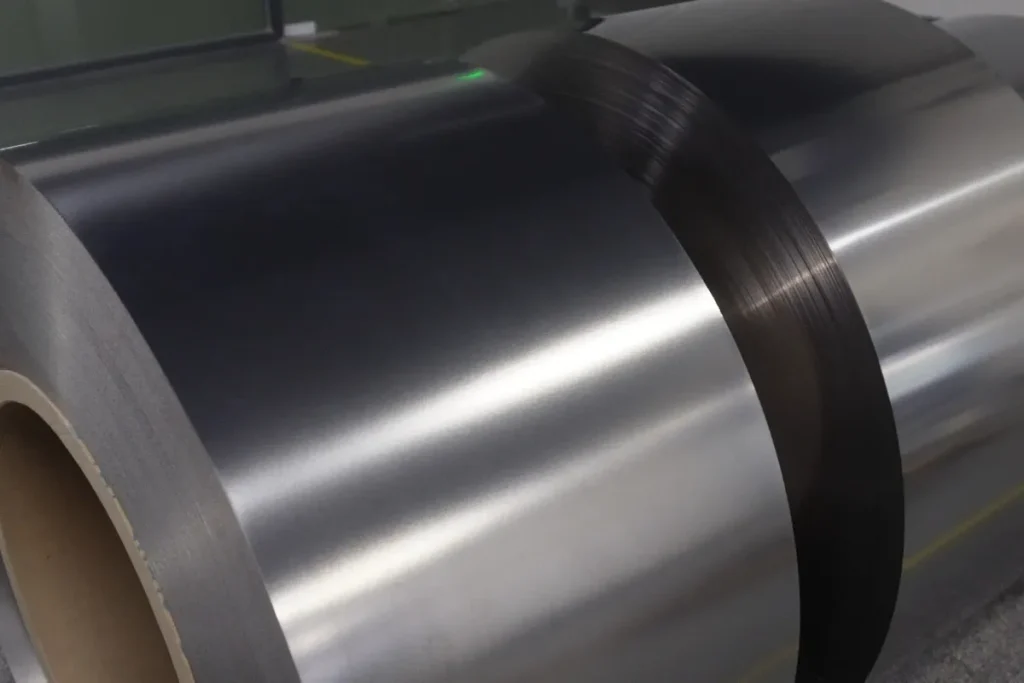
At Huaci Technologies, we leverage our expertise as a high-performance stator rotor manufacturer to push the boundaries of UAV motor technology. Our cutting-edge designs and manufacturing processes are tailored to deliver superior performance, efficiency, and reliability, helping to power the next generation of unmanned aerial systems across diverse industries.